Monday, 2 February 2015

Introduction to Signals

Analogue v's Digital
Analogue and Digital signals are used because they send out information through electric signals. The information can range form audio to video and it is then sent out in electric signals. Analogue signals are translated into electric pulses that vary in amplitude. In digital technology the information sent out is translated into binary so that each bit is representative of of two different amplitudes. The limitation of analogue is that recordings can suffer from distortion and noise. The limitation of digital signal is that  Digital systems are often more expensive than analogue.

Binary, Bits and Bytes
A bit is the smallest piece of computer data. a bit can either represent 0 or 1 by using the electrical states inside computer chips that store and process bits or magnetic bits in disk drives. A byte is 8 bits put together to represent decimal numbers 0 through to 255 by assuming each collections of bits is double the value of the previous group.  Binary is a set of 0 and 1s, 0 being off and 1 being on. Computers can only make calculations using binary.

Synchronous and Asynchronous Transmission
Asynchronous happens outside of real time because the signal is sent at a different clock rate to other signals. Synchronous is when signals in the network are sent at the same time based on one reference clock. The limitation of Asynchronous is important messages arrive at a later time than preferred. The limitation of synchronous is that when signals are based on one reference clock meaning the clock may not have the correct time displayed on it.  

Error Detection and Correction
Error detection occurs when noise or impairments are found in the data during transmission. The error is then found. Error detection makes data transmission more reliable. Error correction is when data that is transmitted contains errors are changed and reconstructed so that the data is clear from any errors. This ensures sent messages do not contain any errors on the receiving side. The limitation of error detection is that it can only find an error but it cannot rectify the error. The limitation of error correction is that the data may not be displayed correctly because of the changes made to the data during the correction process.

Data Transmission
Bandwidth is the speed of which electronic signals travel through a wire, cable or channel. In analogue transmission bandwidth is measured in Hertz or cycles per second. In digital transmission bandwidth is measured in BPS or Bits Per Second. Noise is electrical energy that can disrupt both signals and data while also lowering them in quality. Noise occurs in both digital and analogue hardware. Data compression occurs when users wish to to transfer or store data using less bits. The techniques used to compress data include; CCITT,ARC and ZIP these are the most common ways of compressing data. The limitation of bandwidth is that if the bandwidth is slow then devices will not be as efficient. The limitation of data compression is that it can take a while to compress data particularly large pieces.

Channel Types
A communication channel is a connection between a transmitter and the receiver that data can pass through. There are two types of communication channel which are guided and unguided. Guided is a wired connection and contains wires like twisted pair and fiber optic. These help to make the connection between a transmitter and receiver much quicker and secure. An guided connection is a connection between a transmitter and receiver that contains no wires. So that means things like satellites, radio broadcast and terrestrial microwave are needed to make the connection possible. A limitation of a guided channel is that there are more wires to trip on meaning a higher trip hazard risk. A limitation of unguided channel is that you could lose connection at any moment to this channel especially with satellites.    


Tuesday, 27 January 2015

Data Elements

Cyclic Redundancy Check 
Cyclic Redundancy Check or CRC for short is the method that detects data transmission errors. These transmissions sectioned up into predetermined lengths by a divisor. The remainder numbers are added onto and sent with the message. When the message arrives the computer recalculates the remainder and compares it to the sent remainder. If the numbers do not match up then an error is detected.

Encapsulation-Frames, Packets
Encapsulation allows one network to send it's data to another through network connections. The data that is sent from one network to the other is carried by packets which section up the data and send it over piece by piece. The result is then shown in frames which are a unit of data that help identify packets of data. Frames can also determine how data receivers interpret a stream of data from the source.

Datagrams
A datagram is a packet of data that is sent over an Internet Protocol Network.

Addresses
An address is used to identify a computer or other devices when they connect to a TCP/IP network. The IP addresses given must be unique because otherwise it would be impossible to communicate with other devices.

Sequencing
Sequencing allows for large packets of data to travel across networks quickly but in small amounts and then arrive at the destination in a readable state.


Monday, 26 January 2015

Communication Models and Protocols

Models

Open System Interconnect
The Open System Interconnect or OSI for short is what defines a networking framework for setting protocols in 7 different layers. Control is passed from one layer to the other starting at layer one which is the application layer all the way to the bottom layer which is the physical layer.


TCP/IP
TCP stands for Transmission Control Protocol and IP stands for Internet Protocol. It is a language that a computer uses in order to gain access to the internet. It contains a whole host of protocols that are designed to connect to a network that allows the host access to the internet TCP/IP has 4 layers.


Protocols
Wi-Fi (802.11g)
The 802.11g specification of Wi-Fi is the most common Wi-Fi specification because it offers speeds of 54 megabits per second over a relatively short distance.

Wi-Fi (802.11n)
The 802.11n specification of Wi-Fi is similar to the 802.11g but it instead offers faster speeds of 300 megabits per second over the same distance.

Bluetooth
Bluetooth is a wireless technology that allows devices with Bluetooth switched on to communicate with each other. It is usually used for connections between a desktop computer and a laptop over a short range. Infrared used to do similar things until Bluetooth was created which did all the things Infrared did but it solved a lot of the problems that Infrared had.

3G and 4G
3G is a data transfer technology for mobile phones. It allows people outside of Wi-Fi hot spots to have access to data and transfer it. 3G allows for speeds of at the minimum 2 megabits per second. Some standards of 3G have been known to have speeds of up to 14.4 megabits per second. 4G does all the things 3G does but at faster speeds.

Wireless Security Protocols (WEP, WPA)
WEP is short for Wired Encryption Protocol which is a standard part of wireless networks. It was designed to offer the same security as a wired connection but because of the use of radio waves it is easier to eavesdrop on wireless connections. WPA stands for Wi-Fi Protected Access which was developed to act on WEP's security issues but to use WPA the devices had to be re-configured which annoyed a lot of people.   


Access Methods

What Is CSMA? 
CSMA stands for Carrier Sense Multiple Access. CSMA is a set of protocols or rules that decide what a network should do when multiple devices try to use the same data channel at the same time. A data channel is a route that data from devices travel through. Ethernet networks commonly use CSMA because it monitors the traffic on the line at stations being used. If there is no data being sent out then the station in use can submit data.n When two stations submit data at the same time the data collides and is then detected, after a random time period the two stations will again attempt to submit data.

What is CA? 
CA stands for Collision Avoidance which is when two nodes(connection points) try to access the same piece of data at the same time but the situation is then destroyed. This then means that data can be sent and it will not collide with other data trying to access the same thing.

What is Token Passing?
This is a communications access method that repeats the same frame(token) that is sent from the controlled computer. When a computer sends a message it looks for an empty token and when it does find one it fills it with the address of the destination and all of or most of the message. Nodes constantly search for tokens that are a recipient of a message so that it can mark the token as empty. Token passing is found on the bus and ring topologies.  

Network Software

What is Network OS?
An Network Operating system has unique functions to help connect computers and devices within
the Local Area Network radius. A network operating system allows computers to share data and other things like printer and file sharing amongst computers connected to the same network. The most known operating systems include Microsoft Windows and Mac OS X.

Connection Software 
Connection software is created to help set up and control or monitor the computers networks. Connection software is important for the modern computer networks because it includes internet access and it allows users to share programs and documents with each other.

Thursday, 22 January 2015

Network Services

What is WAP?
The Wireless Access Protocol, or WAP for short, was a communication protocol that allowed wireless device users to gain access to information almost instantly It was later replaced by 3G and then in 2013 4G was developed which is considered to be the most advanced form of network  access outside of WiFi. 

What is Packet Switches?
Packet Switches is when data is divided up into small sections or packets and then sent out to it's intended destinations. When the data arrives at it's intended places it then re-compiles into the original message. Packet switching usually takes place on WAN networks or Wide Area Networks this is so that messages can be sent without slowing down network efficiency.

What is ISDN?
ISDN stands for Integrated Services Digital Network and is a data transfer technology that is able to transfer data much quicker than the usual dial up modem. It also allows for more data to be sent at one time because it enables a wider bandwidth digital transmission.

What is Broadband(ADSL)?
ASDL stands for Asymmetric Digital Subscriber Line. It is used for connecting to the internet. ADSL allows for more data to be sent over copper telephone lines. 

Tuesday, 20 January 2015

Network Topologies

Star Topology
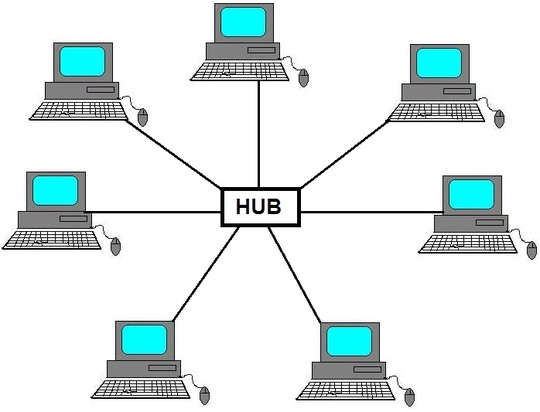
The star topology is a local access network in which all computers are connected to a central hub. it is known as a star because of the shape this type of network usually takes up. Star topology is used mainly in schools and businesses because it is considered to be the most reliable topology.


Mesh Topology
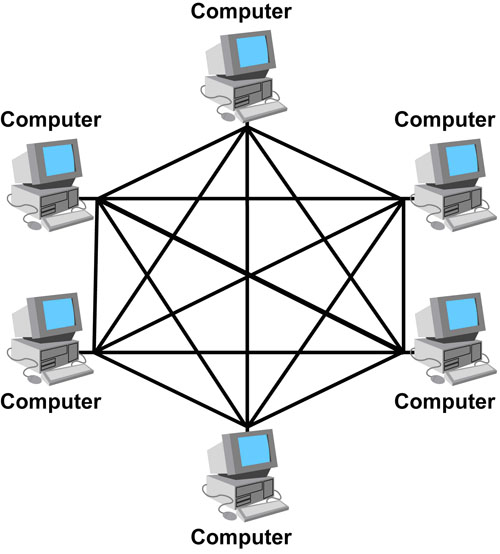
The mesh topology is a type of network in  which computers transmit their own data and is then capable of passing this data on to other computers. Routers are considered to be the best pathway for the computers data to go through. If hardware failure did occur it would mean that there are still routes for the data to go through.


Bus Topology
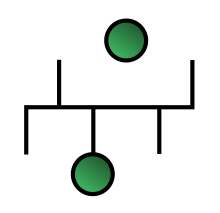
The bus topology is a type of network in which each computer is wired up to a cable or backbone. Bus networks are at their most efficient in small groups meaning less cable is needed but if any section of the network fails all transmissions fail.


Tree Topology
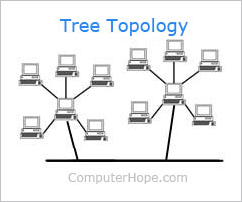
The tree topology is a mixture of both the star and bus topologies. It is the most common network setup that is similar to the bus and star topologies. If a computer was to fail the two stars would be unable to communicate with each other but they can still communicate with those in the same branch.
  
Ring Topology
The ring topology is when the computers are set up so that they make a ring shape. This means that small amounts of data will travel around until it reaches the intended destination.